This post may contain affiliate links. If you use them to buy something, I may earn a commission at no extra cost to you.
Pha That Luang is Vientiane’s famous golden stupa and one of Laos’s most important national and religious monuments.
It is a worthwhile stop for first-time visitors, travelers interested in Buddhist culture, and anyone planning a classic Vientiane sightseeing route.
When I visited, the stupa itself was not as enormous as I had imagined.
Even so, seeing it appear beyond Wat That Luang Tai made me stop in my tracks, and the wider temple complex proved more interesting than a quick photo of the golden monument alone.
This guide covers the main sights, entrance fee, opening hours, suggested visiting time, transport options, clothing, and nearby temples.
Is Pha That Luang Worth Visiting?
Pha That Luang is undoubtedly one of Vientiane’s signature sights.
Its golden stupa stands out from a distance, and its importance as a national and religious monument gives it meaning beyond its appearance.
That said, it is worth setting realistic expectations.
The stupa was impressive, but it did not feel overwhelmingly large when I saw it in person.
The stupa was not as enormous as I had imagined, but I was still glad I visited one of Laos’s most symbolic places.
The wider complex is also part of the experience.
There is a covered cloister around the stupa, temples to the north and south, Buddhist buildings, historic stonework, and a large reclining Buddha.
You can see the golden stupa from outside the ticketed area.
However, the surrounding cloister hides part of its base, so the exterior view does not show the complete structure.
Entering the cloister area gives you a closer view of the stupa and a better look at its substantial base.
ADVICE ADDED
My honest advice is to visit for the whole complex rather than stopping only for a distant photograph of the golden stupa.
What to See at Pha That Luang
The golden stupa is the main attraction, but the nearby temples and covered cloister are what make the visit feel more complete .
Everything described below is close enough to explore on foot within the wider That Luang grounds.
The Golden Stupa
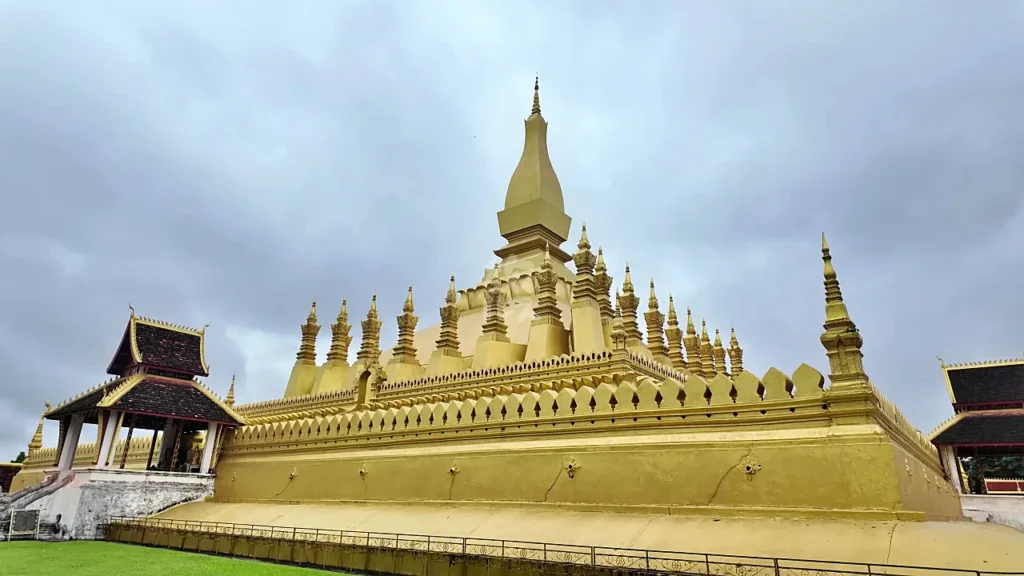
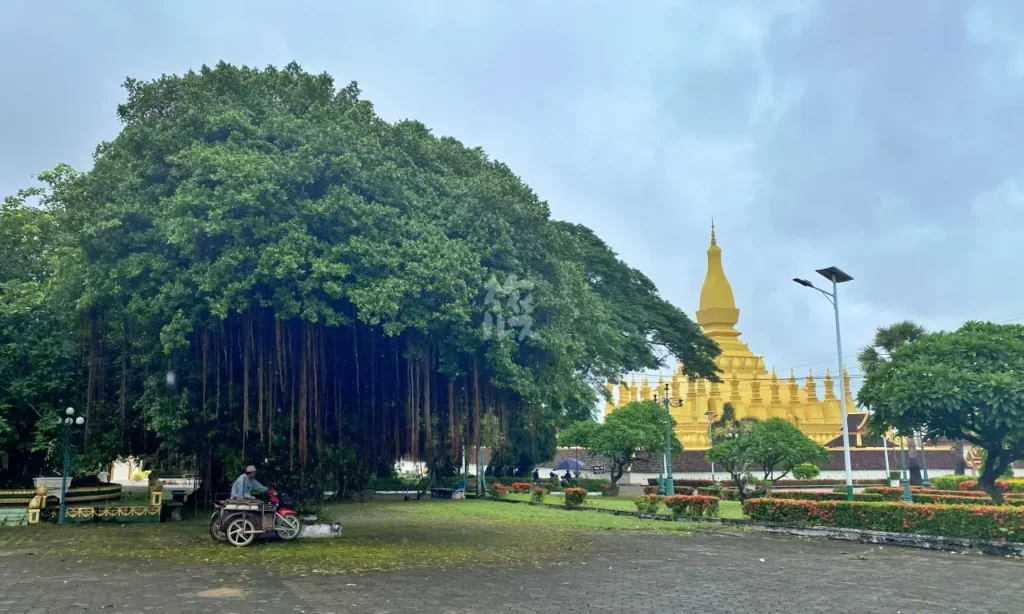
That Luang, visible beyond the temple on the south side The centerpiece of Pha That Luang is its golden stupa, which is approximately 45 meters high.
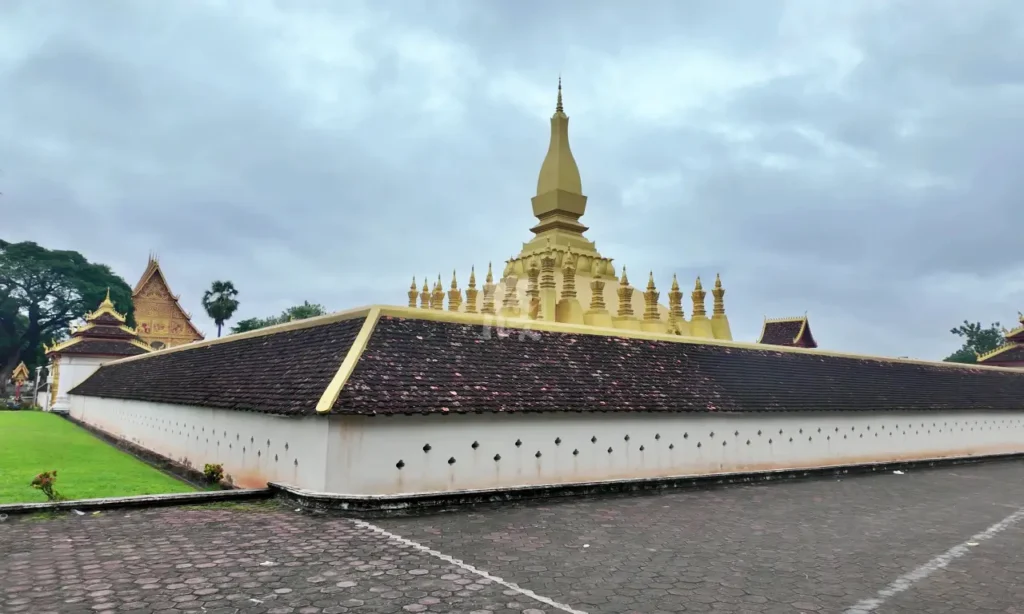
It is clearly visible from a distance, but my most memorable view came from the southern side.
After walking through Wat That Luang Tai, I saw the golden stupa rising beyond the temple and instinctively stopped for a moment.
Seeing such an important symbol of Laos directly in front of me was moving, even though the monument looked more streamlined and less enormous than I had expected.
The stupa is surrounded by a roofed cloister.
You can appreciate its upper section from outside, but the cloister blocks the lower part of the structure.
To see the stupa’s base more clearly and view the monument at close range, enter the inner cloister area.
The Covered Cloister and Historic Stonework
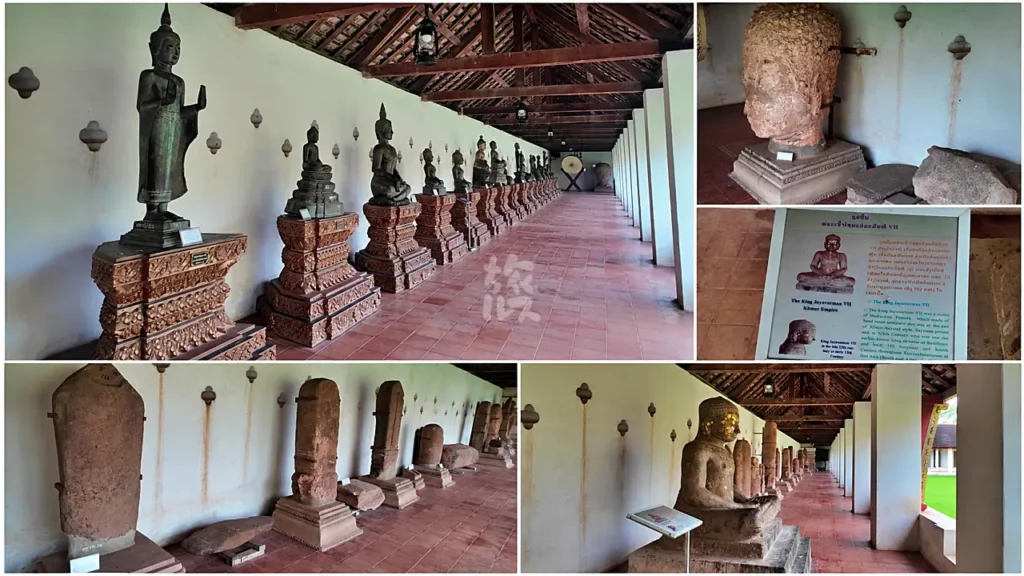
A roofed cloister runs around the golden stupa, allowing visitors to walk a complete circuit.
ADVICE ADDED
Because the view of the stupa changes very little from one side to another, it can be surprisingly easy to lose track of where you are along the route.
The cloister is not just a place to view the stupa.
Along its walls, I found a wider variety of objects than I had expected, including Buddha statues, a large Buddha head, inscribed stone tablets, and damaged stone fragments.
One sandstone sculpture is identified at the site as a figure of Jayavarman VII of the Khmer Empire.
Take time to look at the statues, inscriptions, and stone fragments rather than focusing only on the golden stupa.
Walking slowly around the cloister, with the old stonework on one side and the stupa on the other, creates a quiet sense of stepping away from the modern city for a while.
Wat That Luang Neua and Wat That Luang Tai
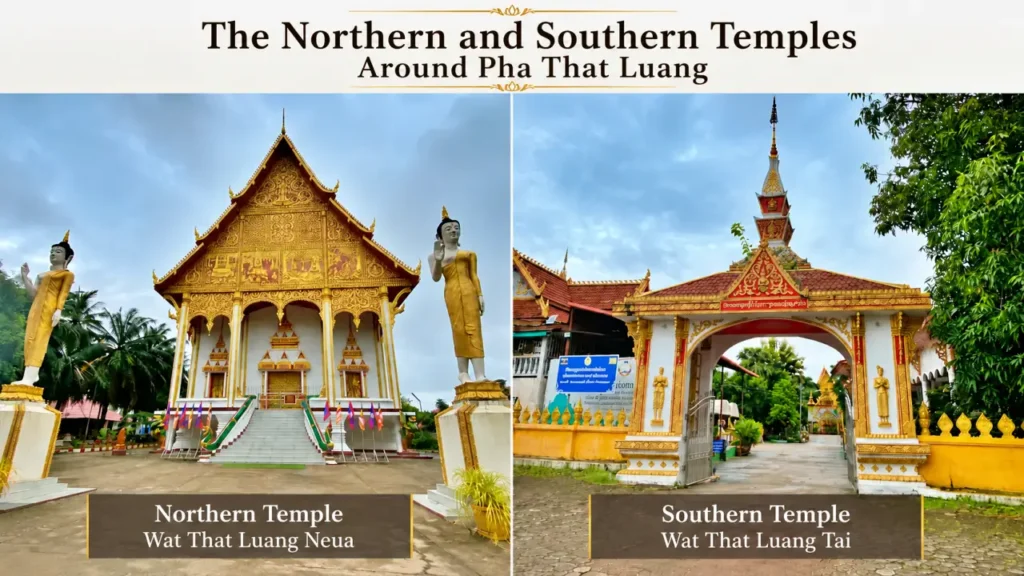
Two major temples stand close to the stupa: Wat That Luang Neua to the north and Wat That Luang Tai to the south.
Both temples are within walking distance of the main stupa and are worth including in the same visit.
Wat That Luang Neua has a large, highly decorated exterior.
My immediate impression was that it looked bold and striking.
Wat That Luang Tai stands on the southern side and has a spacious compound.
When I visited, what appeared to be a celebration was taking place, and the area was crowded.
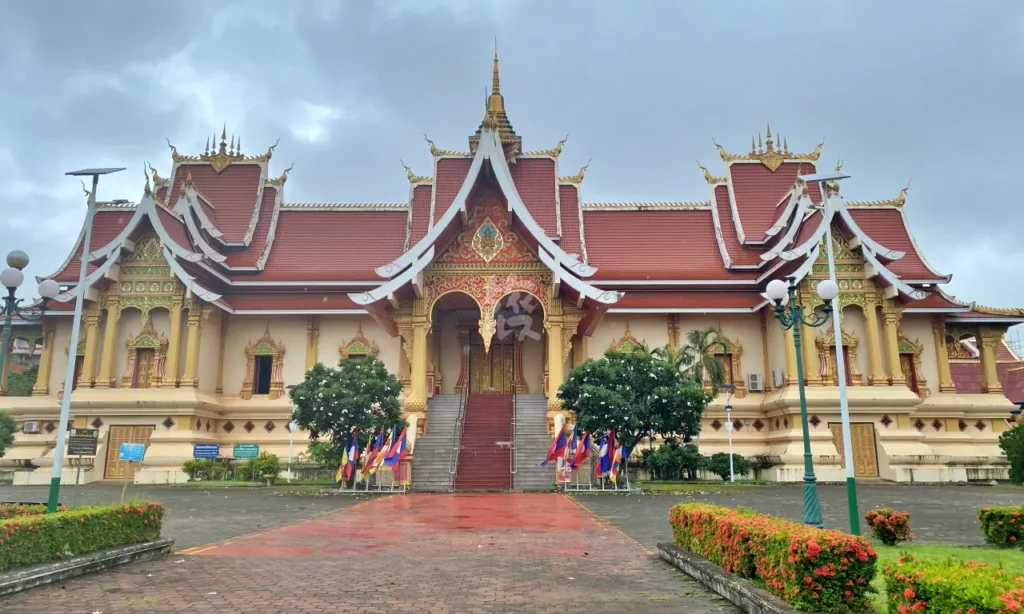
The wider area also includes major Buddhist buildings.
One of the most noticeable was the headquarters of Laos’s central Buddhist organization, with its large structure, red roof, and detailed decoration.
The temples and Buddhist facilities are spread across a broad area rather than being packed closely together.
Walking between them can feel more like strolling through a spacious park than moving between crowded city attractions.
For travelers who enjoy quieter, unhurried sightseeing, the open space and calm walking time are part of the appeal of the That Luang area.
The Large Reclining Buddha at Wat That Luang Tai
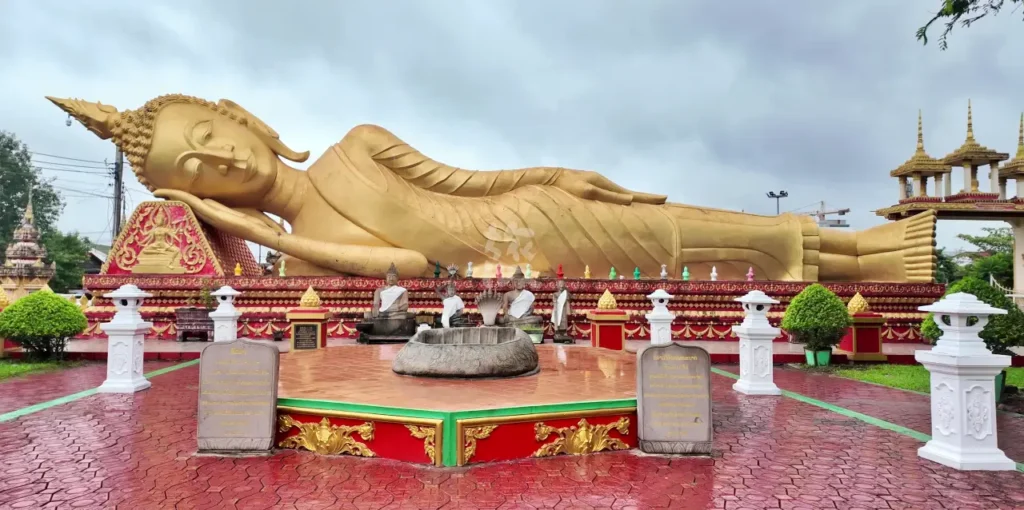
One of the best additional sights is the large reclining Buddha at Wat That Luang Tai, the southern temple.
You can view it from very close range, which makes its size easier to appreciate.
The reclining Buddha can be visited without an additional admission fee.
Souvenir Stalls Behind the Stupa
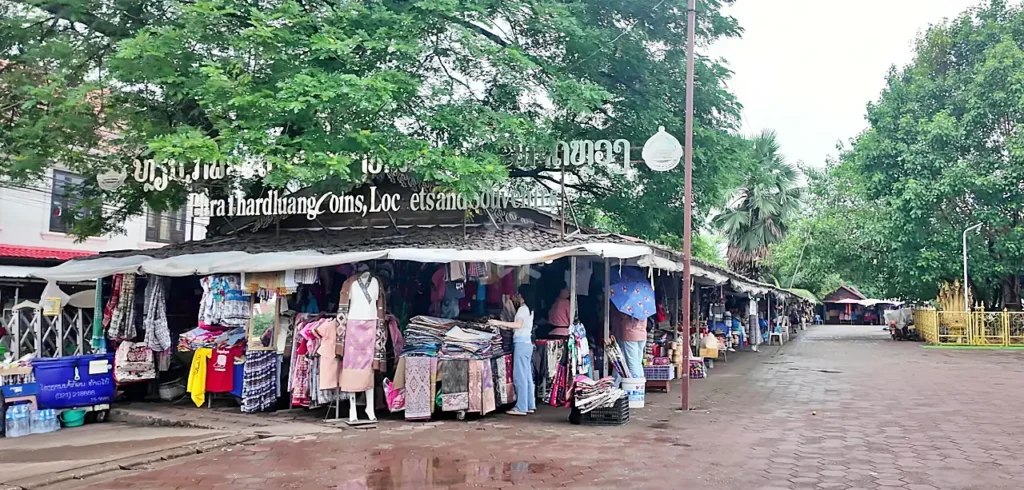
There is a small shopping area behind Pha That Luang with traditional-style souvenir stalls.
The selection includes sinh, the traditional Lao wrap skirt, as well as colorful textiles, scarves, fabric bags, clothes, hats, bamboo items, and accessories.
When I visited, many of the shops carried similar products, and the area felt fairly quiet.
The souvenir stalls may be worth a brief look if you are searching for Lao textiles or traditional gifts, but travelers with limited time can reasonably skip them.
How Much Time Do You Need at Pha That Luang?
The time required depends on whether you want only a quick look at the main monument or a slower walk through the wider grounds.
Type of visit Suggested time Main stupa and covered cloister Around 30–45 minutes Stupa, north and south temples, and reclining Buddha Around one hour Slow visit with photography and relaxed walking Around 1–1.5 hours
Thirty to forty-five minutes should be enough for the stupa and cloister, but around one hour is a better choice if you also want to see the nearby temples.
ADVICE ADDED
Since the wider complex is a major part of the experience, I would avoid planning such a short visit that you have time only for a photograph from outside.
How to Get to Pha That Luang from Central Vientiane
Pha That Luang is some distance from the Mekong riverside, the night-market area, and the central cluster of temples.
It lies farther northeast than Patuxai.
It may technically be possible to walk from the central area, but the combination of distance and Vientiane’s daytime heat can make that an unpleasant choice.
Walking from the central riverside area is not recommended, especially during the hotter part of the day.
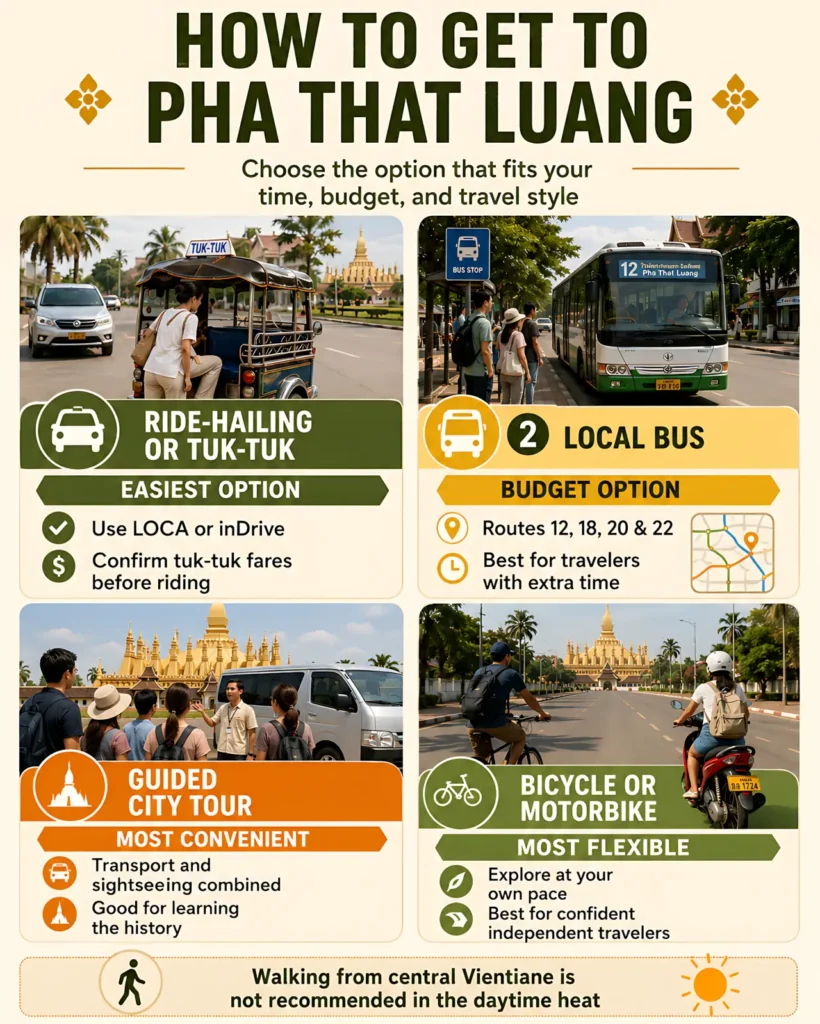
The main options are ride-hailing apps, tuk-tuks, local buses, guided tours, bicycles, and rental motorbikes.
By Ride-Hailing App or Tuk-Tuk
A taxi or tuk-tuk is one of the simplest ways to reach Pha That Luang, particularly when you are visiting Vientiane for the first time and are still learning the layout of the city.
LOCA and inDrive are useful ride-hailing options.
When using a tuk-tuk, confirm the fare before getting in and agree on whether the price is one-way or includes waiting and a return ride .
By Local Bus
Bus routes 12, 18, 20, and 22 serve the That Luang area.
The shuttle bus connecting Wattay International Airport and the LAO ITECC exhibition center can also be used.
Lao-BusNavi
Local buses may suit travelers who have extra time, want to keep transport costs low, and enjoy using local public transportation.
Waiting times can be a disadvantage, so this option may be less convenient when your sightseeing schedule is tight.
By Guided City Tour
A guided city tour can be a convenient option if you want to visit Pha That Luang together with several of Vientiane’s other major attractions.
You do not need to arrange each journey separately, and a planned tour can make it easier to use limited sightseeing time efficiently.
Pha That Luang is closely connected to Lao history and Buddhism.
A guide may therefore be useful for travelers who want to understand why it became a national symbol rather than simply stopping for photographs.
A guided tour is particularly suitable for travelers who want transport and historical context arranged together.
Compare guided tours, transport options, and sightseeing plans!
By Bicycle or Rental Motorbike
Travelers who prefer to explore independently can also travel to Pha That Luang by bicycle or rental motorbike.
This gives you more control over your schedule and allows you to move between sights at your own pace.
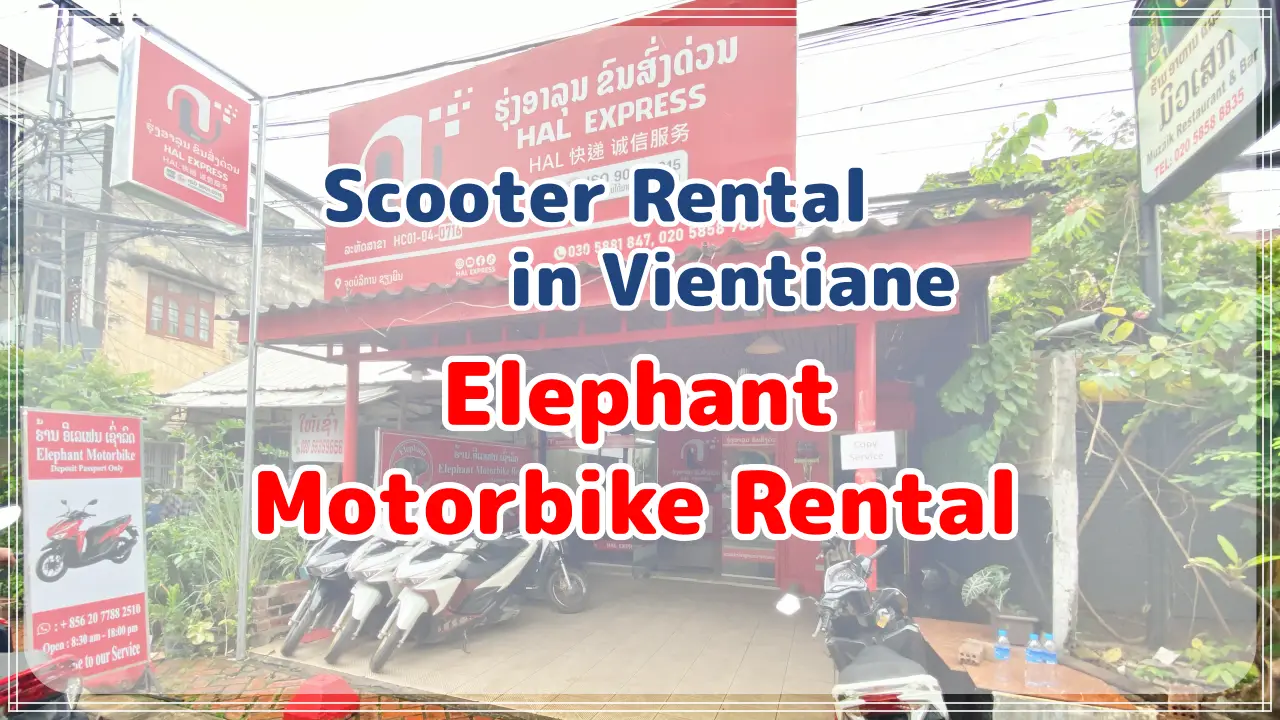
Vientiane has many bicycle and motorbike rental shops.
You can check whether there is one near your accommodation.
This option is likely to appeal most to travelers who already feel comfortable arranging their own transport and route.
Tabilus – Go Travel, Go Missing
What to Wear and Bring
Pha That Luang is a major sightseeing attraction, but it is also an important religious area for Lao people.
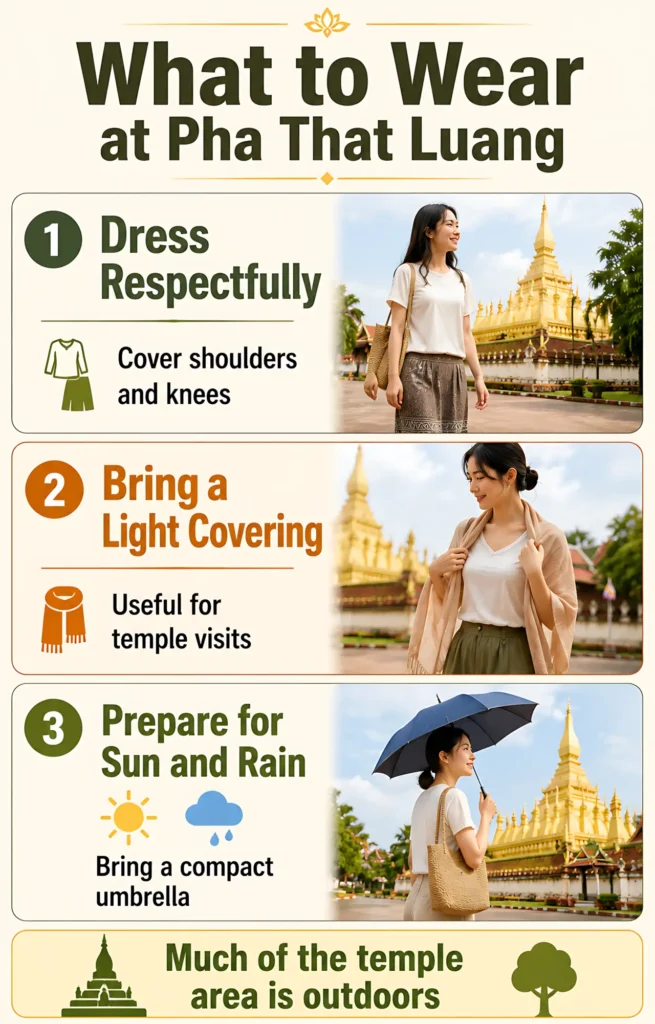
Dress with the same level of respect you would use when visiting other Buddhist temples.
Clothing for a Religious Site
Avoid clothing that exposes too much of the shoulders or legs.
Choose a top that covers your shoulders, and avoid very short shorts or miniskirts.
If your clothing leaves your shoulders or knees heavily exposed, carrying a light covering can be useful.
Sun and Rain Protection
The cloister around the main stupa has a roof, so it is possible to view parts of the monument while staying out of direct sunlight.
However, you will be exposed to the sun when walking between the stupa, temples, Buddhist buildings, and reclining Buddha.
Rain can also occur during the wet season.
A compact umbrella that can be used for both strong sunlight and rain is a practical item for exploring the wider grounds.
Pha That Luang at Night and the That Luang Festival
Pha That Luang can also be combined with evening sightseeing and one of Laos’s major annual Buddhist festivals.
Evening Illumination and the Night Market
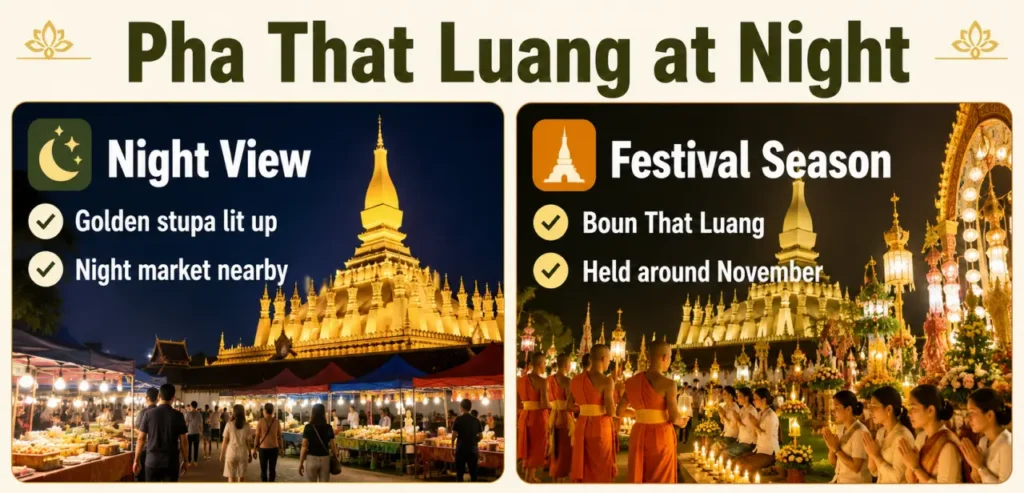
The golden stupa is illuminated at night.
A night market is also held nearby, with food stalls forming the main part of the market.
Visiting the market and viewing the illuminated stupa can offer a different experience from daytime sightseeing.
Boun That Luang Festival
A major festival known as Boun That Luang is held around November, timed around the full moon.
It is one of Laos’s largest Buddhist events.
ADVICE ADDED
The 2026 festival is scheduled to take place from November 21 to November 24.
Why Pha That Luang Is Important to Laos
Pha That Luang is more than an attractive golden landmark.
It is both a national monument and an important religious site connected with Lao history and Buddhist culture.
A National and Religious Monument
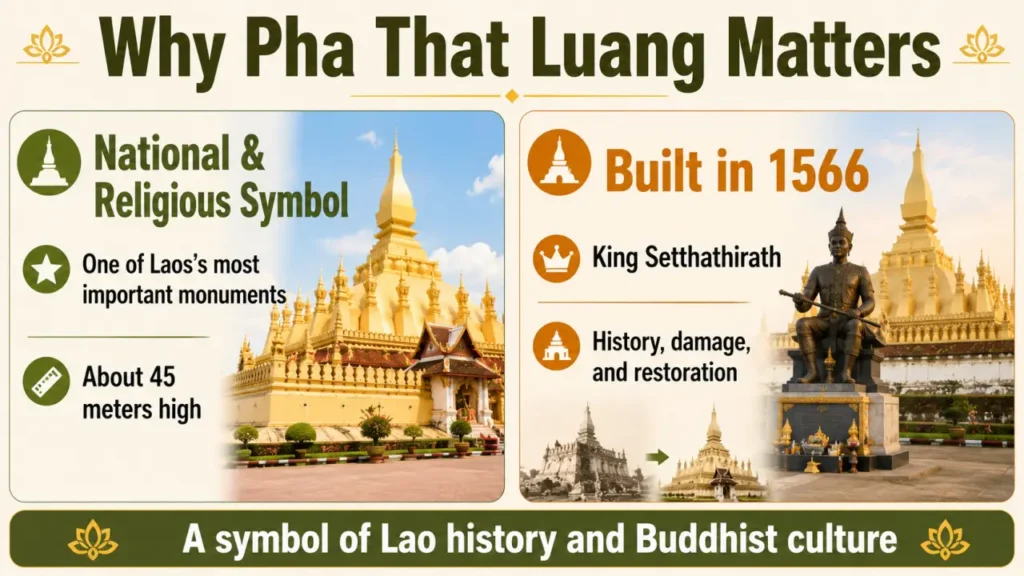
Pha That Luang stands in the Lao capital of Vientiane and is regarded as one of the country’s most important monuments.
Its height is approximately 45 meters.
Although it is not enormous by the standards of the world’s largest monuments, its scale becomes more noticeable when viewed from close range, particularly around its substantial base.
Large temples stand to the north and south, and the headquarters of Laos’s central Buddhist organization is also located nearby.
Together, these buildings make the area feel like a broad religious district centered on the golden stupa.
The 16th-Century Stupa and King Setthathirath
Traditional accounts connect the site’s history with ancient times.
One tradition says that around the third century BCE, Lao monks returning from studies in India brought back a relic identified as part of the Buddha’s breastbone.
A stupa was then built to house it.
This is a traditional account rather than a firmly established historical event.
The present Pha That Luang dates to 1566, when King Setthathirath ordered the construction of a major stupa on a site long regarded as sacred.
King Setthathirath had moved the capital from Luang Prabang to Vientiane.
The monument was later damaged during foreign invasions and reached its present form through repeated reconstruction and restoration.
A statue of King Setthathirath now stands in front of Pha That Luang.
Final Thoughts: See More Than Just the Golden Stupa
Pha That Luang symbolizes both Lao history and Buddhist culture.
The stupa itself was not as huge as I had pictured before visiting.
Even so, I still remember the moment it appeared ahead of me as I walked through the southern temple.
The covered cloister contains old statues and stonework, while the wider grounds include the ornate northern temple and the large reclining Buddha at Wat That Luang Tai.
The wider temple complex is what makes the visit more rewarding than a quick photo stop.
You can see the main stupa in a relatively short time, but setting aside around one hour gives you enough time to include the cloister, temples, and reclining Buddha at a comfortable pace .
Pha That Luang may be less suitable for travelers looking only for an enormous, dramatic monument.
It is a better fit for those who want to see a national symbol, learn something about Lao Buddhist culture, and enjoy a slower walk through a spacious religious complex.
For me, seeing the golden stupa in person became one of the memorable moments of my time in Vientiane.
Compare guided tours, transport options, and sightseeing plans!
\Ready to book? Compare flights and hotels to find the best deal for your dates!/


Comments