
This post may contain affiliate links. If you use them to buy something, I may earn a commission at no extra cost to you.
Having mobile internet in Laos makes it much easier to navigate with Google Maps, book rides through transport apps, and use translation tools while exploring.
There are six main ways to stay connected, from travel eSIMs and local SIM cards to international roaming and Wi-Fi.
My recommendation is to check your existing mobile plan's roaming options first, then compare them with affordable travel eSIMs.
After a local SIM I bought in Luang Prabang stopped working earlier than expected, I've preferred arranging my internet connection before traveling.
In this guide, I'll compare all six options, explain their advantages and drawbacks, and help you work out how much mobile data you might need for your trip to Laos.
Quick Comparison: 6 Ways to Get Internet in Laos
Before choosing a mobile internet option, it helps to understand how the six main methods compare.
| onnection Method | Typical Cost | Main Advantage | Main Drawback |
|---|---|---|---|
| Travel eSIM | Many affordable options | Buy and set up before departure | Requires an eSIM-compatible phone |
| Prepaid travel SIM card | Depends on the plan | Can be arranged before departure | Requires changing your physical SIM |
| Local SIM card | Generally inexpensive | Access to local mobile plans | Purchase and identity registration required |
| International roaming | Depends on your home mobile plan | No need to change SIM cards | Can be expensive |
| Pocket Wi-Fi | Often charged by the day | Connect multiple devices | Requires carrying and charging a router |
| Free Wi-Fi | Usually free | No additional mobile data cost | Limited to locations with Wi-Fi |
Two options worth checking first are eSIMs and international roaming.
An eSIM can be purchased before your trip, allowing you to prepare your phone for use when you arrive in Laos.
Budget-friendly plans can also help keep mobile data costs down.
However, your existing mobile plan may already include international data roaming at no extra charge.
If Laos is covered and the allowance meets your needs, buying a separate SIM might be unnecessary.
Traveling with a phone that doesn't support eSIM?
A physical SIM card or pocket Wi-Fi may be a better fit.
Your choice may also depend on whether you're traveling alone, with family, or as part of a group.
What to Check Before Choosing a SIM or eSIM for Laos
Before buying a travel SIM or eSIM, there are two important things to check: your current mobile plan and your phone's compatibility.
Check Your Mobile Plan's Roaming Coverage in Laos
Some mobile plans include overseas data roaming without additional charges.
If your plan covers Laos, you may be able to keep using your usual SIM without buying anything else.
However, roaming allowances, eligible countries, data limits, and the number of days covered vary by provider and plan.
Check whether Laos is included in your mobile plan's roaming coverage, along with any additional charges or data limits.
The best place to confirm these details is your mobile provider's official website.
Check Your Phone's eSIM Compatibility and Carrier Lock
To use a travel eSIM, your phone must support eSIM technology.
One way to check is to open your phone's dialer and enter *#06#.
If an EID number appears, that's an indication that your phone supports eSIM.
However, compatibility alone isn't enough.
Even an eSIM-compatible phone may be unable to use a travel eSIM if it's locked to your mobile carrier.
This is particularly worth checking if you bought your phone through a mobile provider.
If you're planning to use a physical travel SIM instead, make sure your phone can accept a SIM from another provider.
How Much Mobile Data Do You Need in Laos?
One of the trickiest parts of choosing a travel eSIM or SIM card is deciding how much data to buy.
The amount you need depends on how you use your phone, especially whether you watch videos, upload photos, or share your connection with other devices.
Estimated Data Usage for a 5-Day or 7-Day Trip
Here's a general guide to mobile data usage during a trip to Laos.
| How You Use Your Phone | Daily Estimate | 5-Day Trip | 7-Day Trip |
|---|---|---|---|
| Maps, WhatsApp, and web searches | 500MB | 3GB | 4–5GB |
| Social media browsing and photo uploads | 1GB | 5GB | 7GB |
| Frequent social media and short videos | 2GB | 10GB | 14GB |
| Video streaming and frequent hotspot use | 3GB or more | 15GB or more | 21GB or more |
Actual data consumption depends on video quality, app settings, and how often you connect to hotel Wi-Fi.
If you're mainly using Google Maps, WhatsApp, iMessage, and web searches, your data needs may be relatively modest.
Watching videos on Instagram or YouTube, on the other hand, can quickly increase your usage.
If you're unsure where to start, consider around 1GB of mobile data per day.
You may need more if you frequently stream videos or share your connection.
Avoid Unexpected Data Usage from Photo and Video Backups
One thing that's easy to overlook is automatic photo and video backup.
If your phone automatically uploads photos and videos to iCloud or Google Photos, it may use a surprising amount of mobile data without you noticing.
Consider turning off automatic photo and video backups or setting them to upload only over Wi-Fi.
This is especially useful if you're taking lots of photos during your trip.
6 Ways to Stay Connected in Laos: Pros and Cons
Now let's look at each connection method in more detail, including who it's best suited for and what to watch out for.
1. International Roaming: Use Your Existing Mobile Plan
International roaming is one of the simplest ways to stay connected in Laos.
International roaming is one of the simplest ways to stay connected in Laos.
Your usual mobile provider connects your phone to a partner network overseas, so there's no need to swap SIM cards or buy a new eSIM.
If international roaming is already included in your mobile plan, this can be a particularly convenient option.
However, roaming fees in Laos can vary significantly depending on your mobile provider and plan.
Some providers charge a daily rate, which can add up over a longer trip.
For example, a plan costing US$12 per day would come to US$84 over seven days.
This is an illustrative calculation, not a quote for a specific mobile provider.
Depending on the available eSIM prices, a separate travel eSIM could work out much cheaper.
Another thing to check is whether standard voice calls and SMS messages are billed separately from your roaming data allowance.
Otherwise, you could end up with unexpected charges.
Check the total roaming cost for your trip before deciding whether to use your existing SIM or buy a travel eSIM.
2. Travel eSIMs: Convenient and Often Affordable

Travel eSIMs have become an attractive option for travelers who want to arrange mobile data before leaving home.
Some travel eSIMs can be purchased and installed before departure, so you only need to switch to the travel connection when you arrive in Laos.
Because you don't need to remove your regular SIM card, there's also no risk of misplacing it while swapping cards.
Most travel eSIMs can be installed using a QR code or a dedicated app.
However, some plans require additional APN settings, so the setup process isn't always completely automatic.
It's also important to follow the provider's installation instructions because some eSIM plans begin their validity period as soon as they're installed.
eSIM Prices: Budget Providers vs. App-Based Services
Prices for Laos travel eSIMs can vary considerably between sellers.
Travel platforms such as Trip.com and KKday offer inexpensive eSIM options for Laos, while specialist providers such as Airalo may be more expensive for certain plans.
Depending on the plan, a budget travel eSIM may even cost less than buying a local SIM card in Laos.
A cheaper price doesn't necessarily mean a worse connection.
I bought a budget travel eSIM through Trip.com and had no connection problems while using it in Laos.
The downside was that the setup took a little more effort than I would have liked.
Airalo, meanwhile, offers a dedicated app for purchasing, installing, and managing supported eSIM plans, which can make the process more convenient.
Whether you prioritize the lowest price or easier management may influence which provider you choose.
Make Sure Your eSIM Actually Covers Laos
Not every travel eSIM provider sells plans for Laos.
This is especially important if you're visiting several Southeast Asian countries, such as Thailand, Vietnam, and Laos.
A product marketed as a Southeast Asia or regional Asia eSIM doesn't necessarily include Laos.
Always check the list of supported countries before buying a travel eSIM.
What Happens If You Run Out of Data?
It's worth finding out how you'll check your remaining data and what happens when your allowance runs out.
I found this surprisingly inconvenient with the budget eSIM I bought.
Checking my remaining balance was such a hassle that I ended up not checking it at all.
With supported Airalo plans, you can check your remaining data through the app.
Depending on the eSIM, using up your allowance may mean your data connection stops or your speeds are reduced.
Some plans let you buy additional data, while others require you to purchase a new eSIM.
Airalo also allows top-ups through its app for eligible plans.
Before choosing an eSIM, check whether you can easily add more data if you run out.
One more thing: many travel eSIMs are data-only.
Apps such as WhatsApp, LINE, and iMessage can work over the internet, but a data-only eSIM may not provide regular phone-number-based calls or SMS.
If you need traditional calls or SMS during your trip, check the plan's features before purchasing.
If you need traditional calls or SMS during your trip, check the plan's features before purchasing.
3. Physical Travel SIM Cards: An Alternative to eSIM
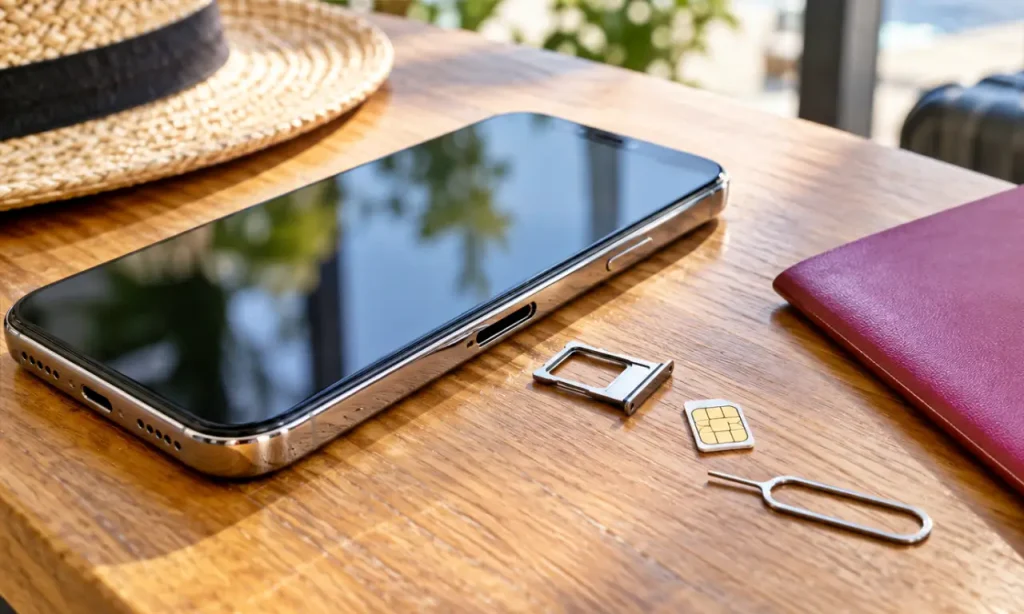
If your phone doesn't support eSIM, a prepaid physical travel SIM is another option.
You can buy travel SIM cards before departure through online retailers or specialist SIM sellers, depending on what's available in your country.
This lets you prepare your connection without having to find a SIM shop after arriving in Laos.
Some physical travel SIMs also cover several countries, which can be useful if you're visiting Thailand or Vietnam on the same trip.
However, a product labeled "Asia SIM" or "Southeast Asia SIM" may not include Laos.
Check that Laos is explicitly listed as a supported country and that your phone is unlocked.
You'll also need to replace your usual physical SIM with the travel SIM.
4. Local SIM Cards in Laos: Buy After Arrival
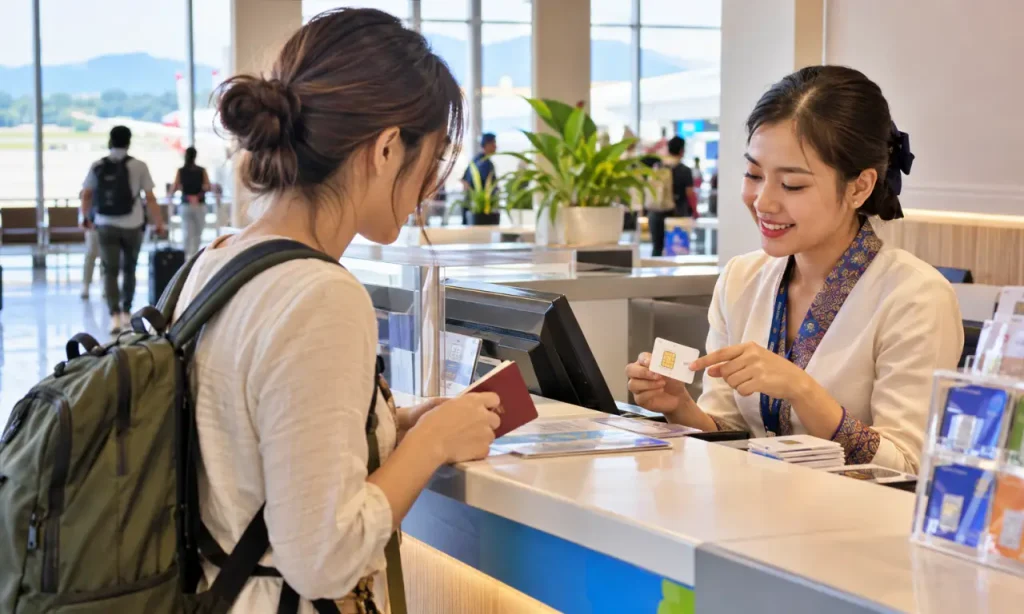
You can also buy a local SIM card once you arrive in Laos.
Major airports in Laos have counters selling SIM cards. You can buy a SIM card after arrival and start using it shortly afterward.
However, airport SIM counters may be closed if you arrive late at night.
If you're arriving late, don't assume you'll be able to buy and activate a SIM at the airport.
SIM cards are also available from shops in town.
Some of the mobile operators in Laos include Unitel, Lao Telecom, and ETL.
Local SIM cards can be attractive because they offer access to plans designed for the domestic market.
They may be particularly useful if you want an affordable plan for a longer stay or need a Lao phone number.
Luang Prabang Airport to City Center: 5 Ways to Get There, Prices & Travel Times
Passport Registration for Local SIM Cards
SIM card users in Laos are required to register their identity, and foreign visitors generally use their passports for registration.
This requirement also applies to data-only local SIM cards, not just SIMs that include voice calls.
Staff at some shops can help with registration and activation.
I'd recommend buying from an official operator counter or an authorized retailer when possible.
Before leaving the shop, make sure your SIM is activated and you can actually connect to the internet.
I learned the importance of having a reliable connection after a frustrating experience at Luang Prabang Airport.
I bought a local SIM with a seven-day plan, but it stopped working after just three days.
I never found out what caused the problem.
Since then, I've preferred preparing my mobile connection before departure rather than relying entirely on buying a SIM after arrival.
5. Pocket Wi-Fi and Mobile Hotspots for Groups
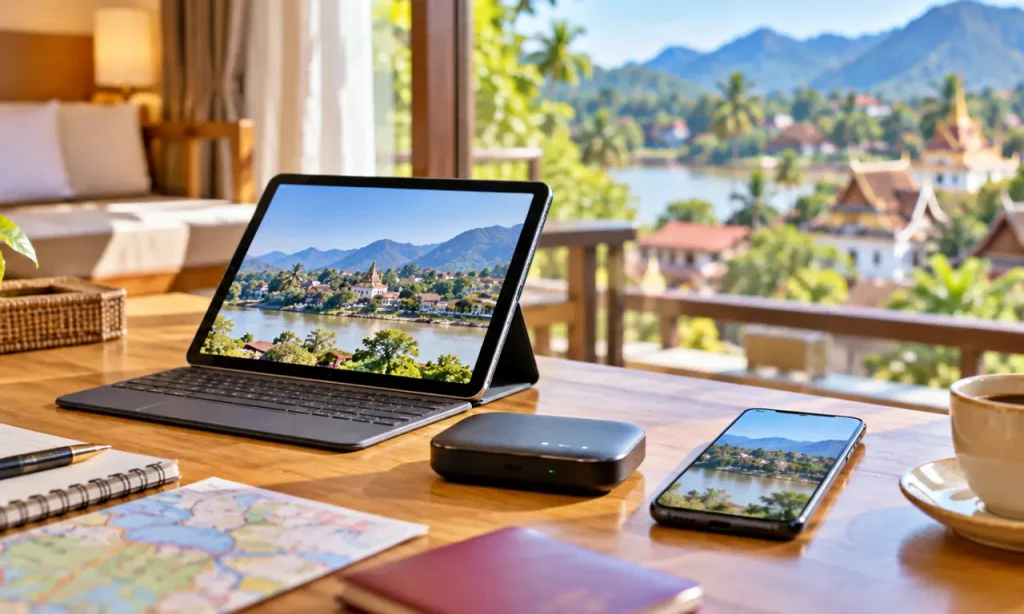
Pocket Wi-Fi is a small, portable router that lets you connect multiple devices to the internet.
Depending on the available service, you may be able to rent a router before departure or use a mobile Wi-Fi device that supports Laos.
Be sure to check that the service actually covers Laos.
The main advantage of pocket Wi-Fi is that several devices can share one connection.
This can be useful if you're traveling with family or carrying a phone, tablet, and laptop.
It's also an alternative if your phone doesn't support eSIM and you don't want to swap physical SIM cards.
However, you'll need to carry the router, keep it charged, and possibly return it after your trip if it's rented.
Rental costs may also include shipping or optional protection fees.
For a fair comparison, look at the total cost for your entire trip rather than just the advertised daily price.
Can You Just Use Your Phone as a Hotspot?
Yes, phone tethering can sometimes replace a portable Wi-Fi router.
For example, one person could buy an eSIM and share their phone's mobile data with another family member.
That means you won't need to carry an additional router.
However, not all eSIM plans allow tethering, and using your phone as a hotspot can drain its battery faster.
Sharing one connection works best when your group stays together.
If you often split up to explore different places, having a separate connection for each person is likely to be more convenient.
6. Free Wi-Fi in Laos: Useful as a Backup
Free Wi-Fi is available at many hotels, guesthouses, and cafés in Laos.
It's useful for saving mobile data, but relying on it for your entire trip can be inconvenient.
You might want to look up directions on Google Maps or contact your hotel while you're out exploring, only to find that there's no Wi-Fi available nearby.
I've actually tried traveling using only Wi-Fi from cafés and restaurants.
In the end, I spent more on cafés than I would have on mobile data, and the connection speeds and stability varied between places.
I recommend treating free Wi-Fi as a supplement to mobile data rather than your only internet connection.
For example, you could use an eSIM while exploring and switch to your hotel's Wi-Fi when uploading photos or videos.
Is Public Wi-Fi Safe?
Free public Wi-Fi isn't always secure.
Be careful with unencrypted networks and connections shared by large numbers of people.
Many websites and apps already encrypt their traffic, so simply connecting to public Wi-Fi doesn't mean your passwords will immediately be exposed.
However, fake Wi-Fi hotspots and suspicious login pages are still worth watching out for.
If you often use hotel or café Wi-Fi, you may also want to consider a VPN.
A VPN can reduce the risk of others on the connected Wi-Fi network reading your internet traffic.
Many VPN services support several devices, including smartphones, tablets, and computers.
However, a VPN doesn't protect you from every online threat.
For example, it won't prevent phishing if you enter your password into a fake website.
You also need to trust the VPN provider itself, so it's worth reviewing its privacy policy before choosing a service.
Personally, I use Proton VPN, which offers a no-logs policy, as part of my approach to online privacy.
Which Internet Option Is Best for Your Laos Trip?
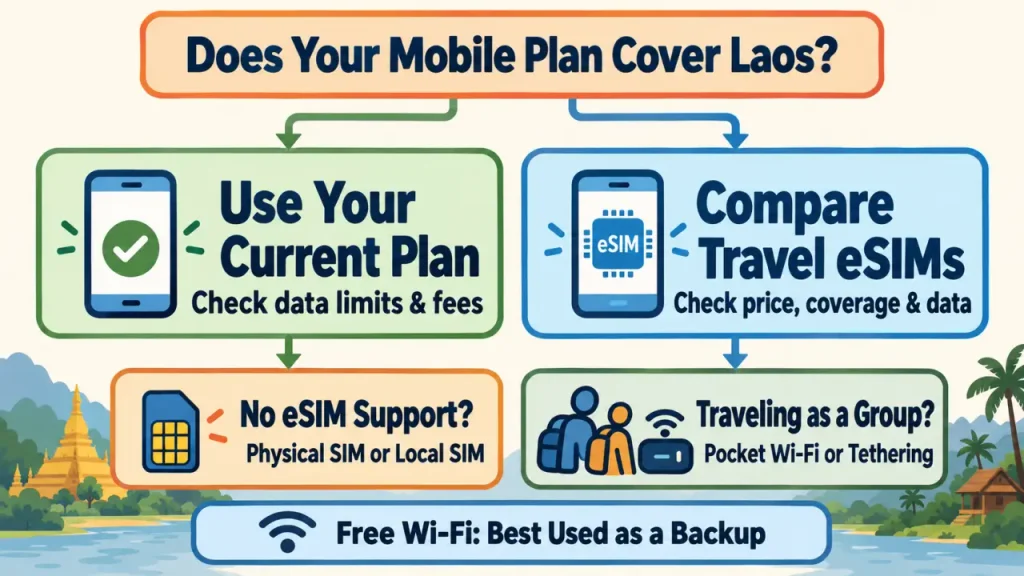
Each of the six methods has its advantages and disadvantages, so the best choice depends on your phone, mobile plan, budget, and travel style.
My preferred approach is to check whether international roaming is included in your existing plan, then compare the total cost with a travel eSIM.
If roaming would be expensive, budget eSIMs from sellers such as Trip.com or KKday are worth comparing.
For travelers who prioritize convenient data management and the option to top up eligible plans, a service such as Airalo may be appealing.
If your phone doesn't support eSIM, consider a prepaid physical travel SIM or a local SIM after arrival.
Pocket Wi-Fi is another option if you'd rather avoid changing SIM cards or want to connect multiple devices.
Families and groups can also consider sharing a connection through pocket Wi-Fi or phone tethering.
However, individual eSIMs may sometimes cost less than a shared device, especially when several people are traveling together.
If you expect to spend time apart, separate mobile connections are usually more practical than sharing one.
Here's a quick guide to help you decide.
| Your Situation | Option to Consider |
|---|---|
| Your existing mobile plan includes roaming in Laos | International roaming |
| You want to minimize mobile data costs | Budget travel eSIM |
| You prefer easier data management and top-ups | An eSIM service such as Airalo |
| Your phone doesn't support eSIM | Physical travel SIM or pocket Wi-Fi |
| You're staying longer or need a Lao phone number | Local SIM |
| You're traveling with family or sharing several devices | Pocket Wi-Fi or phone tethering |
| You want to reduce your mobile data usage | Hotel or café Wi-Fi as a supplement |
Before You Go: Final Mobile Internet Checks for Laos
Having mobile internet in Laos can make everyday travel much easier, whether you're checking directions, using a translation app, booking transport, or contacting your accommodation.
Before departure, make sure your chosen connection method supports Laos, works with your phone, and offers enough data for your trip.
It's also worth checking how much the full plan will cost and what options you'll have if you run out of data.
With a little preparation, you can spend less time worrying about your connection and more time enjoying your travels in Laos.
Comments