
This post may contain affiliate links. If you use them to buy something, I may earn a commission at no extra cost to you.
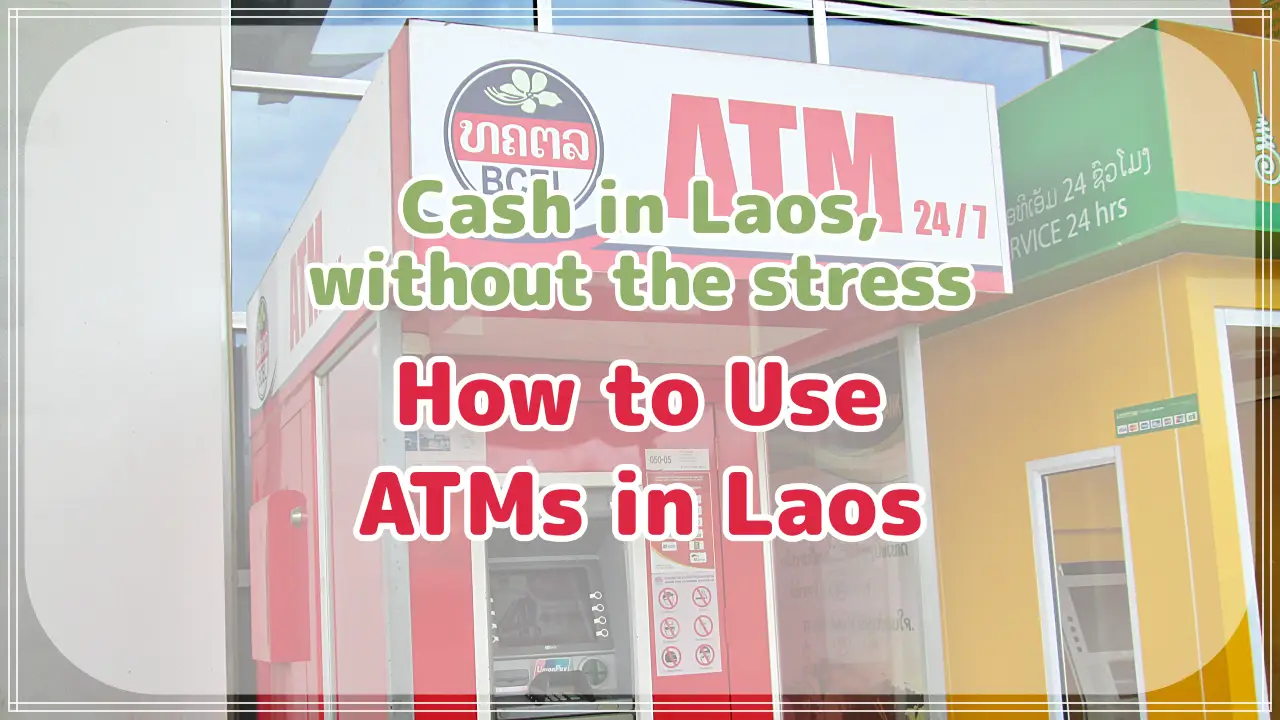
Traveling in Laos, I quickly realized that having a reliable way to get local cash makes the whole trip feel much calmer.
Even though card payments are spreading, you’ll still need cash for markets, street food, and small guesthouses.
In this guide, I’ll walk you through how ATMs work in Laos, where to find them, which cards you can use, and what kind of fees, withdrawal limits, 100,000-kip notes, and minimum withdrawal amounts to expect.
I’ve followed exactly these steps myself, so if overseas ATMs make you nervous, this article is here to make the process feel simple and predictable.
It’s not flashy luxury — it’s the quiet kind, where knowing you can get cash 24/7 lets you relax and focus on the trip itself.
More to Explore in Luang Prabang




Quick Answer: Laos ATM Fees, Limits, and Minimum Amounts
In Laos, many ATMs commonly dispense 100,000-kip notes, so 100,000 kip is often the smallest practical amount travelers should expect to withdraw.
However, the exact minimum withdrawal amount depends on the bank and the machine. Some ATMs may allow smaller or different amounts, while others may reject amounts that do not match the notes available inside the machine.
For foreign cards, many ATMs charge a fixed fee of around 30,000–40,000 kip per transaction. Some banks may charge a percentage-based fee instead. Always check the fee shown on the ATM screen before confirming your withdrawal.
Do you really need cash in Laos, and is it safe to use ATMs?
When you travel in Laos, you’ll find that cash is still essential, even though more shops, hotels, and tour companies now accept cards.
Many smaller places only take cash, so it’s smart to keep some money in your pocket.
You can exchange money at banks and exchange counters, but using an ATM lets you withdraw local currency 24 hours a day and sometimes at a better rate than over-the-counter exchanges, depending on timing.
If overseas ATMs make you anxious, the good news is that the basic flow is almost the same everywhere.
In this article, I’ll show you each screen and step you can expect so you’re not guessing in front of the machine.
If you’re worried about using an ATM in public, choose a machine that’s inside a bank branch or shopping mall, where it’s well-lit and busy.
What should you know about Lao kip before withdrawing cash?
The currency in Laos is the Lao kip (LAK).
Kip is a currency that is very hard to exchange outside Laos, so if you take it home, it may be difficult or impossible to convert back into your own currency.
Try not to leave the country with a lot of leftover kip. Plan your withdrawals with your remaining days and expected spending in mind.
The main banknotes you’ll see in circulation are:
- 1,000 kip
- 2,000 kip
- 5,000 kip
- 10,000 kip
- 20,000 kip
- 50,000 kip
- 100,000 kip
ATMs most often dispense 100,000-kip notes, and sometimes you’ll get a thick stack of 50,000-kip notes instead.
Because of this, 100,000-kip is often the smallest practical withdrawal amount for travelers using ATMs in Laos.
This does not always mean every ATM has an official 100,000 kip minimum.
The actual minimum depends on the bank, the machine, and the notes available inside the ATM.
If your chosen amount does not work, try one of the preset amounts shown on the screen or choose a slightly larger amount.
The exchange rate between kip and major currencies (USD, EUR, etc.) changes all the time, so it’s better to check the live rate in a widget or currency app right before you withdraw.
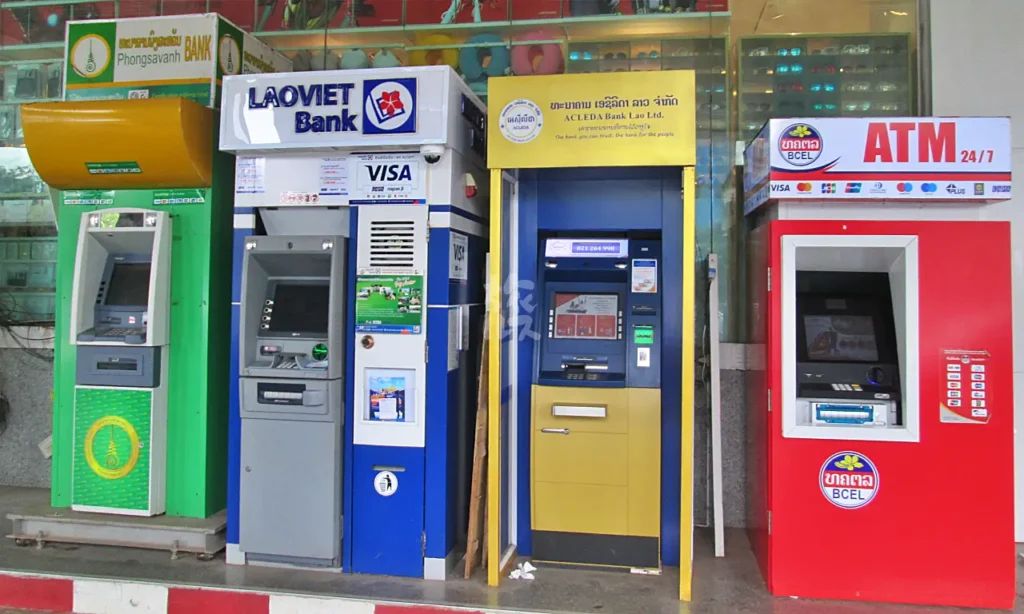
Where can you find ATMs in Laos?
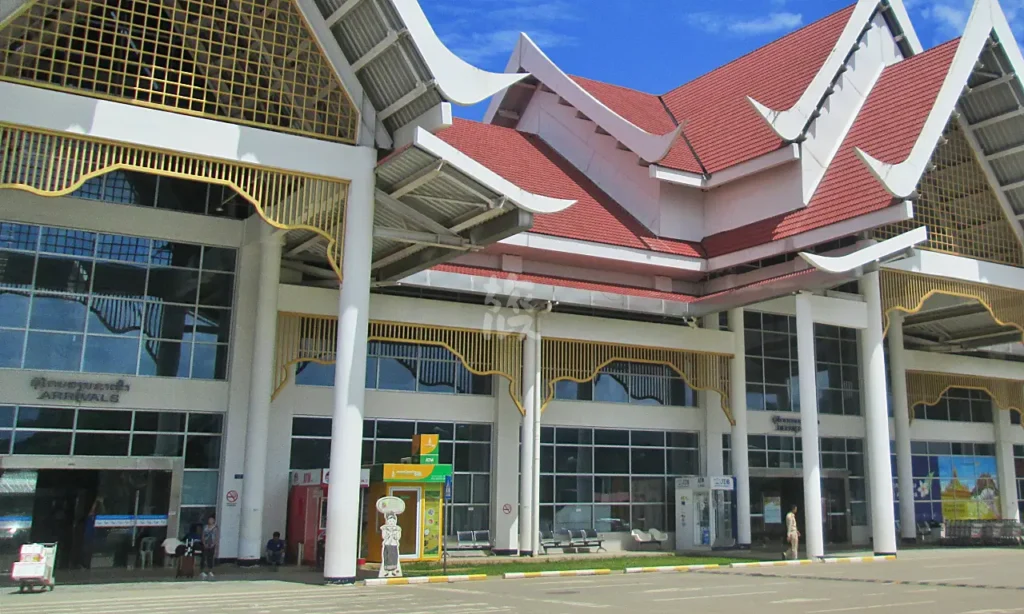
ATMs are widely available in Laos, even in many regional towns.
You’ll most often find them:
- At airports
- Inside or just outside bank branches
- In or near shopping malls and supermarkets
In cities, they’re almost everywhere, so you rarely need to worry about “running out” of ATMs.
As you walk around, it’s a good idea to mentally note ATMs you pass near your hotel, favorite cafés, or main intersections.
I usually remember one or two “regular” machines along my daily route so I know exactly where to go when my wallet gets low.
Which card brands usually work at ATMs in Laos?
The card brands you can use depend on each ATM, but Visa and Mastercard are the most reliable options.
You can expect these two brands to work at most ATMs, and they’re also commonly accepted at hotels, restaurants, and tour companies.
Because of that, it’s best to travel with at least one Visa or Mastercard, ideally two from different issuers for backup.
Later in this article, I’ll introduce BCEL, a major Lao bank whose ATMs accept a wide range of card brands, including some less common ones.
Step-by-step: how to withdraw cash from an ATM in Laos
From here, let’s go through the actual steps of using a Lao ATM.
The basic process is almost the same on every machine, so once you’ve done it once, it feels much easier the second time.
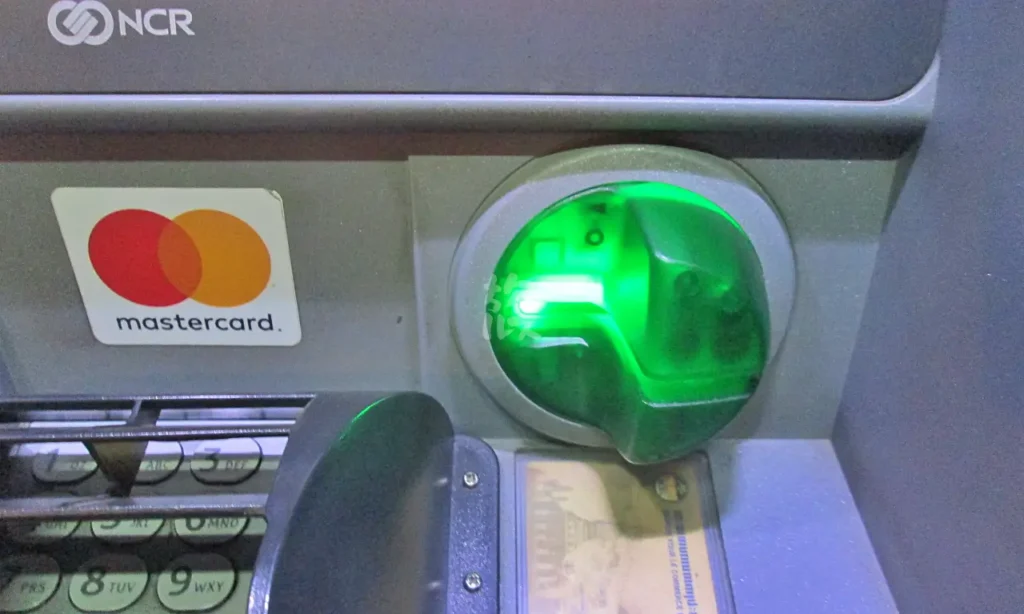
Insert your credit card (or debit card) into the ATM.
Make sure the card is facing the right way and follow the on-screen diagram carefully.
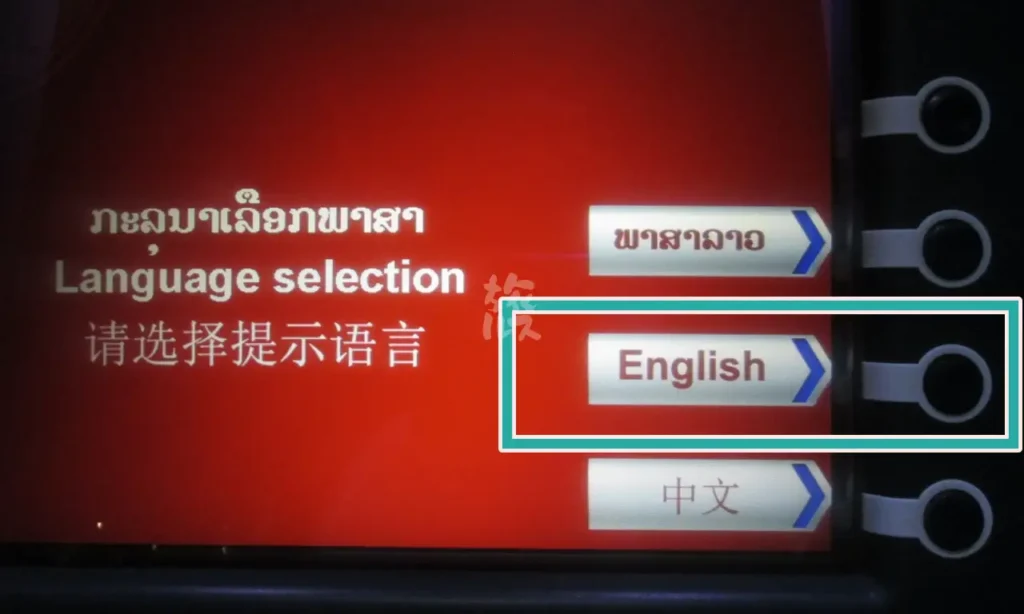
On most ATMs, the first screen lets you choose a language.
Select “English” so you can follow the instructions comfortably.
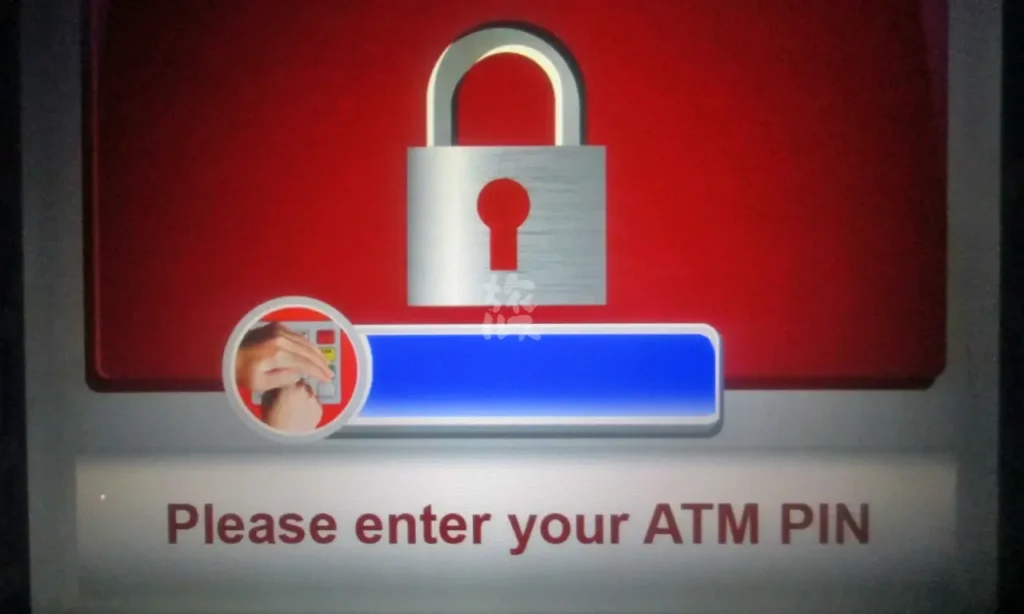
Enter the 4-digit PIN (personal identification number) you set when you received your card.
If you enter the wrong PIN several times, the card can be locked, so take your time and don’t rush.
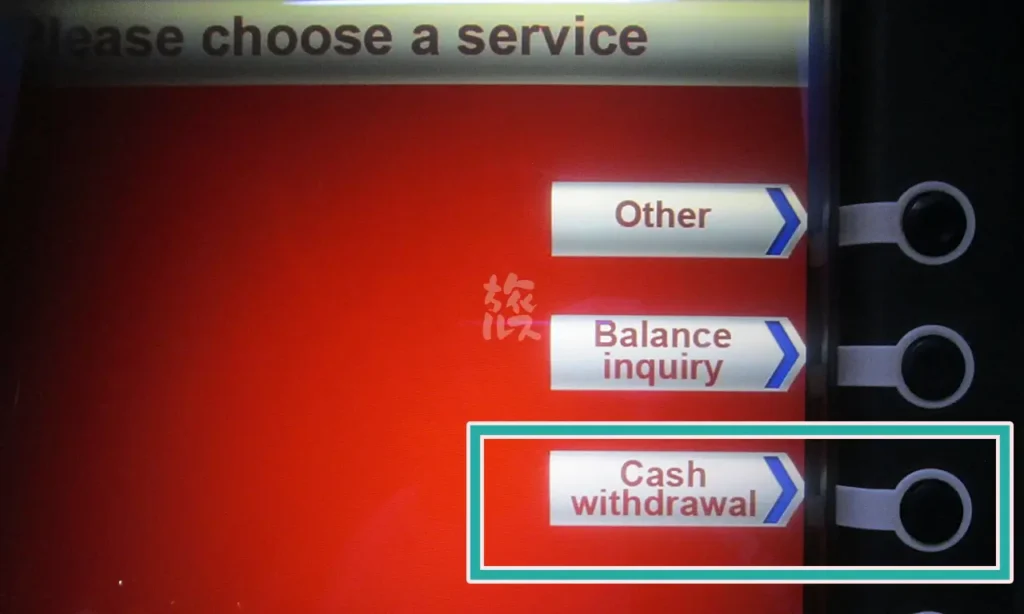
Tap the button labeled “Cash Withdrawal”, “Withdrawal” or similar.
Some ATMs will then ask you to choose the type of account:
- Savings (for a regular bank account / debit card)
- Current (for a current account)
- Credit (for a credit card cash advance)
If you’re taking a cash advance on a credit card, choose “Credit”.
If you’re using a debit card linked to your bank account, choose “Savings.”
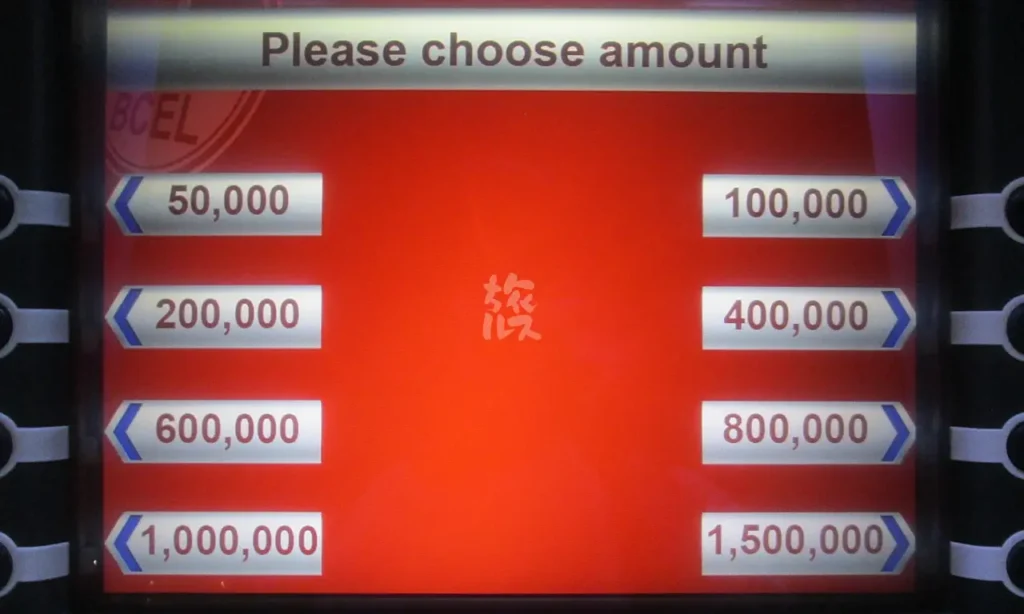
Next, select the amount you want to withdraw.
Some machines show fixed amounts on the screen; others allow “Other amount” so you can type in a number yourself.
If you try to withdraw a very small amount, the ATM may reject it or ask you to choose a different amount.
In many cases, choosing an amount based on 100,000-kip units works more smoothly because many machines dispense 100,000-kip notes.
Each ATM has its own maximum per transaction, so you may get an error if you try to withdraw more than its limit.
If you need more cash, you can do multiple withdrawals in separate transactions.
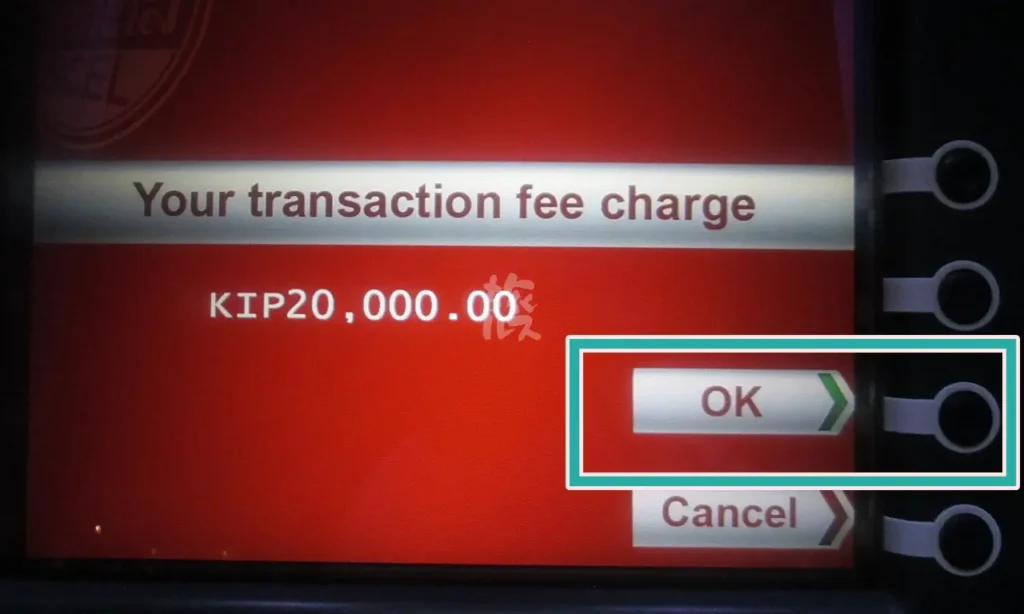
Before the ATM dispenses cash, it will show the ATM fee for that transaction.
Check the amount displayed and press “OK” or “Accept” if you agree.
The machine will then dispense your cash.
Don’t forget to take your card and receipt as well as the money—this is easy to forget when you’re relieved to see the notes come out.
If anything on the screen looks unclear, it’s completely okay to cancel the transaction and move to another ATM from a well-known bank.
What is the minimum withdrawal amount at ATMs in Laos?
There is no single minimum withdrawal amount that applies to every ATM in Laos.
In practice, however, many travelers should expect 100,000 kip to be the smallest practical amount to withdraw, because ATMs in Laos commonly dispense 100,000-kip notes.
Some machines may let you choose smaller amounts, especially if they have 50,000-kip notes available, but this depends on the bank and the machine.
If the ATM rejects your chosen amount, select one of the preset amounts on the screen or try another ATM nearby.
This is also one reason not to withdraw too much at the end of your trip. Lao kip can be difficult to exchange outside Laos, so it is better to withdraw only what you can realistically spend.
How much are ATM fees and withdrawal limits in Laos?
ATM usage fees
In Laos, you should assume every bank will charge some kind of ATM fee when you withdraw cash with a foreign card.
- Many ATMs charge a fixed fee of around 30,000–40,000 kip per transaction.
- Some ATMs, such as those from JDB, charge a percentage fee, for example 3% of the amount withdrawn with a minimum of 40,000 kip.
Because the fee is usually “per transaction”, it’s cheaper overall to withdraw a larger amount a few times, rather than small amounts many times.
If the fee shown on the screen feels too high, you don’t have to continue—just cancel the transaction and try another bank’s ATM nearby.
Typical per-transaction withdrawal limits
Each bank sets its own per-transaction withdrawal limit.
These are examples from when I used ATMs in Laos:
- BCEL: 2,500,000 kip per transaction, ATM fee 30,000 kip
- Indochina Bank: 3,000,000 kip per transaction, ATM fee 40,000 kip
- JDB: 2,000,000 kip per transaction, fee 3% (minimum 40,000 kip)
These limits and fees can change without notice, so always rely on what you see on the ATM screen at that moment, not on older information.
When I tested different banks, I found that knowing the limits in advance helped me plan how much to withdraw so I didn’t have to stand at the machine doing trial and error.
Which ATMs in Laos are the most convenient for travelers?
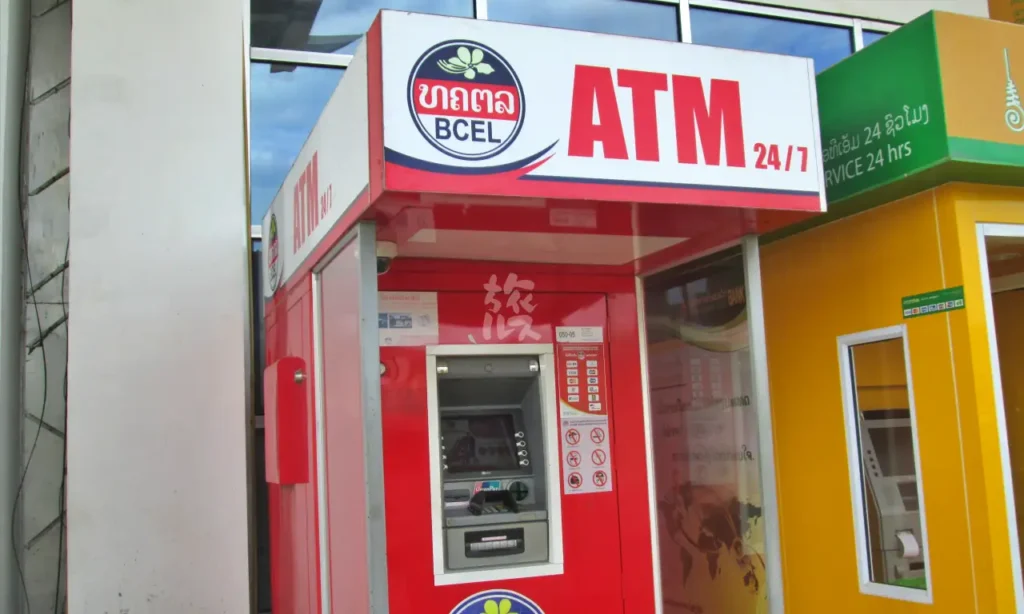
Overall, my personal recommendation is BCEL ATMs.
From my experience, BCEL is convenient because:
- It’s one of the largest banks in Laos, with ATMs in many cities and towns.
- The per-transaction limit of 2,500,000 kip is relatively high, and the ATM fee of 30,000 kip is reasonable compared with others.
- BCEL ATMs accept a wide range of card brands: Visa, Mastercard, Maestro, Cirrus, Diners Club International, JCB, and China UnionPay (CUP).
For smaller withdrawals, remember that the minimum amount can still depend on the machine and the notes available at that moment.
If a small amount does not work, try choosing one of the preset withdrawal amounts shown on the BCEL ATM screen.
Because of this, I usually look for a BCEL ATM first when I arrive in a new town and then remember where it is for the rest of my stay.
If you find a BCEL ATM that works smoothly with your card, it’s worth noting its location in your map app so you can return to the same machine later.
Pros and cons of using a credit card for cash advances in Laos
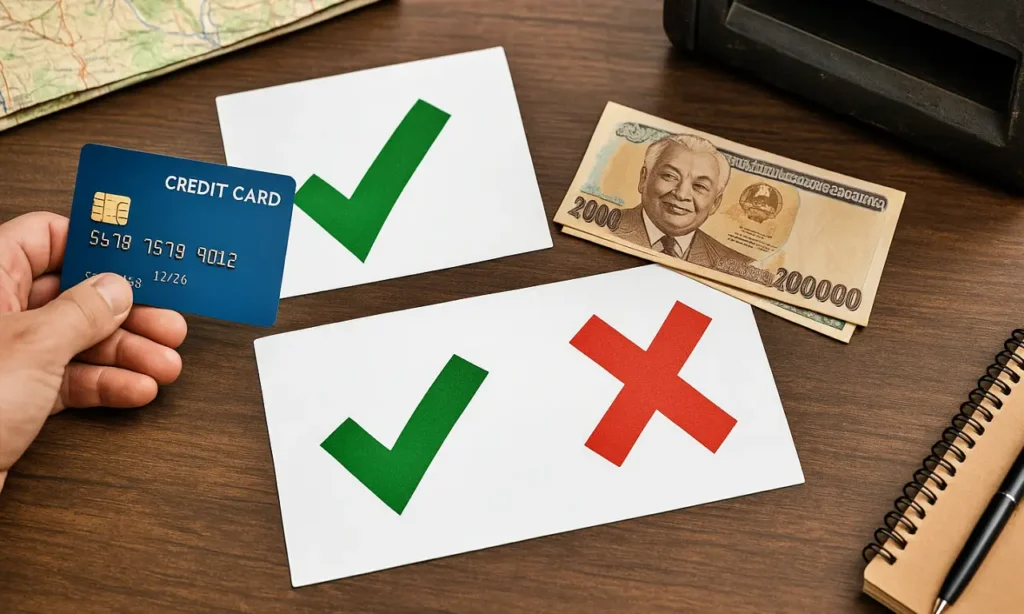
Using your credit card for a cash advance (cash withdrawal) is a very easy way to get local currency, but it does come with downsides.
Knowing both the advantages and disadvantages helps you use it only when it really makes sense.
Advantages of credit card cash advances
1. Often better rates than cash exchange
Credit card cash advances usually use the international card-network exchange rate plus a small adjustment.
Cash exchange counters often give worse rates, so in many cases the rate you get from a cash advance is more favorable than over-the-counter exchange.
2. Some cards don’t charge foreign transaction fees on cash advances
When you use a credit card for shopping abroad, many issuers add a foreign transaction fee on top of the exchange rate.
For cash advances, however, some cards do not charge this foreign transaction fee at all, which can make cash advances cheaper overall than simply paying by card in shops with the same card.
By contrast, most debit cards charge a foreign transaction fee when used at overseas ATMs, so the total cost can be higher than you expect.
3. You don’t have to carry large amounts of cash
If you exchange a lot of money in cash, you’ll be walking around with a thick wallet, which increases the impact if it’s lost or stolen.
With cash advances, you only withdraw what you need at the moment, so you’re not carrying a huge stack of notes.
If your credit card itself is lost or stolen, you can contact your card issuer and have the card blocked quickly, which is a big safety advantage.
Disadvantages of credit card cash advances
1. High interest rates
Cash advances are treated as short-term loans, so interest starts accruing from the withdrawal date until the repayment date.
It’s best to choose a card that allows easy early repayment and to repay the full amount as soon as possible to keep interest costs low.
2. ATM fees plus card-issuer fees
As we’ve seen, Lao banks charge their own ATM fees.
On top of that, some card issuers charge an additional “overseas ATM fee” for each cash advance.
Because these two layers of fees add up quickly, it makes sense to prefer cards that don’t charge an extra overseas ATM fee where possible.
3. Cash advance limits
Each credit card has a maximum amount you’re allowed to withdraw as cash, known as your cash advance limit.
This limit may be lower than your total credit limit, and your requested limit may not always be approved at the level you originally applied for.
In some cases, you might not have any cash advance limit set at all.
It’s important to check and adjust your cash advance limit before you leave for Laos, so you’re not surprised at the ATM.
FAQ: Using ATMs in Laos
Is 100,000 kip the minimum withdrawal amount at ATMs in Laos?
Not always officially.
However, because many ATMs in Laos commonly dispense 100,000-kip notes, 100,000 kip is often the smallest practical amount travelers should expect to withdraw.
Can I withdraw less than 100,000 kip from an ATM in Laos?
It depends on the bank and the machine.
Some ATMs may allow smaller amounts if they have smaller notes available, but others may reject the transaction or ask you to choose a different amount.
How much are ATM fees in Laos?
Many ATMs charge around 30,000–40,000 kip per transaction for foreign cards.
Some banks may charge a percentage-based fee instead, so always check the fee shown on the ATM screen before confirming.
What is the withdrawal limit at BCEL ATMs in Laos?
From my experience, BCEL ATMs allowed withdrawals of up to 2,500,000 kip per transaction with a 30,000-kip ATM fee.
However, fees and limits can change, so check the ATM screen before you confirm.
Do Laos ATMs usually give 100,000-kip notes?
Yes, many ATMs in Laos commonly dispense 100,000-kip notes.
Sometimes you may also receive 50,000-kip notes depending on the machine and cash availability.
Use credit card cash advances wisely on your Laos trip
ATMs are one of the most convenient ways to get Lao kip 24/7, and once you’ve used them once or twice, they stop feeling intimidating.
The basic process is the same in most countries, so the experience you gain in Laos will help you on future trips too.
From my own travels, I feel that cash advances are becoming more attractive compared to traditional cash exchange, especially in countries where exchange counters offer poor rates.
At the same time, the hidden costs—interest, ATM fees, and possible card-issuer fees—are easy to forget when you’re standing in front of the machine.
Remember that Lao kip is hard to exchange once you leave the country, so the key is to withdraw only what you can realistically spend instead of “just in case” amounts.
At the same time, remember that very small withdrawals may not always work, especially when the ATM mainly dispenses 100,000-kip notes.
If this is the kind of practical, low-stress travel you want, using ATMs and credit card cash advances in a planned way will give you a quiet sense of security throughout your trip.


\Ready to book? Compare flights and hotels to find the best deal for your dates!/
Comments